%20(1).png?width=200&height=63&name=Promet%20Logo%202019-01%20(1)%20(1).png)

Thanks for attending my session. Everything below is something I demoed during the talk, used to build the talk, or would hand a colleague who asked where to start. The sections follow the order of the talk.
If you have five minutes, go to Things to try on Monday. If you are writing a contract or an RFP, start with Security, Standards, and Policy.
The session
Open the Claw, Close the Ticket: full deck
All slides from the session. Covers the five claws, the vendor landscape, three demo workflows, and what happens when residents start sending agents to your website.
NAGW National Conference
The conference program and the rest of the sessions.
Nightly Sweep
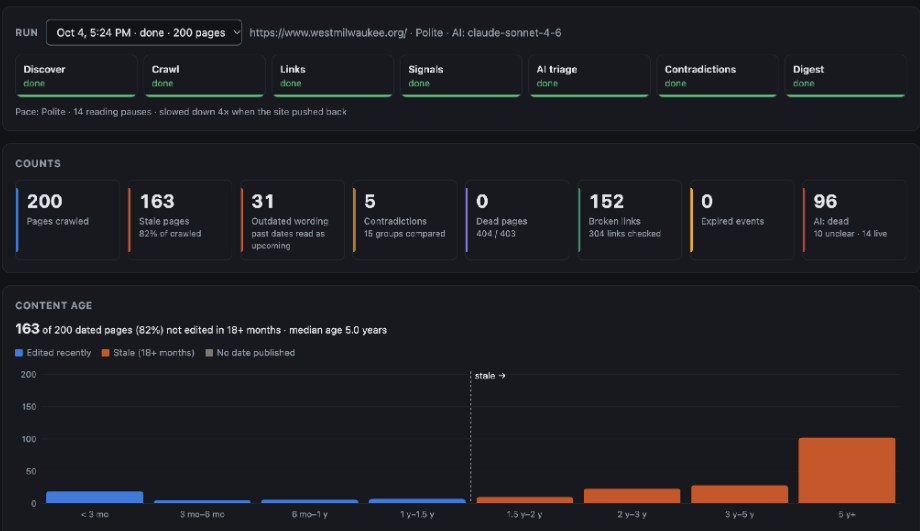
The first demo from the talk. It crawls a public site overnight and reports dead links, expired events, pages untouched for 18 months, and forms posting to a dead address. It is read-only and cannot change anything on your site.
Score an assistant's answers
Ask a public assistant, with browsing turned on, your ten most common resident questions. Mark each answer right, wrong or missing. A wrong answer often traces back to a page you retired, and a missing one means the service is invisible to the assistant.
Write one skill file
A workflow can be a plain text file: crawl every page, flag dead links and expired events, flag pages untouched for 18 months, email the digest, change nothing. Write down one recurring check from your own team the same way.
What to refuse
-
Any agent with shell access.
-
Any instance reachable from the internet.
-
Any multi-year AI pricing commitment.
Getting the vocabulary straight
Stanford HAI AI Glossary
Plain definitions of terms you will hear in vendor demos, including agentic AI, alignment, benchmarks, hallucination and inference. A useful single reference to send a colleague.
Brief Definitions of Key Terms in AI
A shorter explainer aimed at policymakers. Useful if you need two pages to hand a council member or a department head.
Artificial Analysis Intelligence Index
Independent benchmarks for major models, with cost and speed alongside capability. Check the index version before quoting a number, because scores get recalculated.
What you may already be paying for
If you license Microsoft 365 or Google Workspace, agentic features are probably already inside your tenant, with real limits in the government versions.
Microsoft 365 Copilot in US government clouds
What reached GCC and GCC High in April 2026, from Microsoft.
Gemini Enterprise reaches FedRAMP High
Google's agent platform, formerly Agentspace, with FedRAMP High authorization.
Copilot Studio: government cloud feature availability
The feature-by-feature table. Check it for autonomous triggers and computer-use agents, which the session flagged as limited or unavailable in government clouds.
Frontier and developer platforms
The model is a commodity. What matters is where it runs, what it can touch, and who patches it.
OpenAI Frontier
OpenAI's platform for building and governing agents across an organization.
OpenAI AgentKit
OpenAI's developer toolkit. Its Agent Builder launched in October 2025 and is scheduled to shut down on November 30, 2026, which shows how fast this category changes.
GovAI Coalition
Started by the City of San José to address shared concerns about data privacy, vendor transparency and governance. It publishes AI policy templates, a vendor AI FactSheet and standard contract language that any agency can adopt. This is the agency coalition, separate from the GovAI vendor product named in the talk. If you take one link from this page, start here.
NSA guidance on Model Context Protocol security
The NSA's May 2026 guidance on connecting agents to your systems safely, including separating tools by data sensitivity. It lists security gaps in the protocol that need to be addressed before it can be used with confidence.
FIDO Alliance: standards for trusted agent interactions
Work on proving that a person authorized what their agent is doing, comparable to a power of attorney.
What OpenClaw reveals about agentic AI security risks
IBM X-Force's analysis of the OpenClaw incidents covered in the session. Read it before anyone self-hosts an agent.
The OpenClaw security timeline
A timeline of the OpenClaw vulnerabilities and exposure. Counts differ by source and date, so cite the source and date when you quote one.
OpenClaw
Background on OpenClaw, the open-source agent covered in the session.
Rules to give any vendor
-
The shell stays closed.
-
Default deny, then allow.
-
Never reachable from the internet.
-
Approval gates on public content and records.
-
Agent logs may be public records, so decide retention first.
-
Provision it like a new employee, not an admin.
-
Do not deploy what you cannot patch in a week.
Two sentences for your next RFP
"Describe how our agent configurations and workflow logic can be exported, and what happens to them if we terminate."
"Describe how you identify an agent acting on a resident's behalf, and how we would permit that rather than block it."
Few vendors have a good answer to the second question yet, so asking it now shapes what they build.
If your site runs on Drupal
Your content management system already has roles, permissions, revisions, and an audit trail. That is the governance layer an agent needs.
Drupal AI Initiative
The community effort, its workstreams, and how to get involved.
Drupal, AI agents, and governance
The argument that external agents should invoke your CMS's own workflows instead of reproducing its rules outside it.
From our team
Our own writing on AI in the public sector. As I said in the session, Promet Source sells a product in the chatbot category, so weigh the ideas and the vendor separately.
AI solutions for the public sector
How we approach AI for government agencies.
Civic AI Navigator: AI chatbot for local government
Learn about our government-grade chatbot, built to address concerns about hallucination and data privacy in public-facing tools.
How to build a chatbot for a county website, with a checklist
A step-by-step guide to implementing an AI chatbot on your website, covering planning, development, deployment, and maintenance.
Comparing six government CMS platforms
This practical guide gives you a comparison of six widely used government CMS platforms, so you can make a confident, future-proof choice on your next CMS.
Webinar: A safe path to AI on Drupal for government
Practical AI use cases inside a Drupal editor, plus the infrastructure side.
Questions after the session?
If you build one of these, I would rather hear what broke than what worked, and I will share what broke for me.
Andy Kucharski, President and CEO, Promet Source · Presented at the NAGW National Conference, Milwaukee, October 7, 2026. Vendor features and pricing change often, so confirm details against current vendor documentation before you buy.